Rose
Leave the World BehindRose is Amanda and Clay’s younger child and Archie’s sister. On a family trip away from Brooklyn, she sees an immense gathering of deer that no one else has witnessed, then carries that knowledge through a day marked by unnatural quiet, a sudden noise, and growing uncertainty. Her importance lies in the contrast between her family’s failure to recognize the scale of the danger and her willingness to act on what she has seen: when Rose goes missing, she is not simply lost in the woods but pursuing a solution she believes her family needs.
Identity and Family
Rose is a young girl approaching adolescence. She has already asked to be called Rose rather than Rosie, making a small but firm distinction between the name her family uses and the identity she wants recognized. During the drive to the family’s vacation, she posts photographs of the trip soon after the car crosses the county line. Like Archie, she has a phone with games and parent-approved social media, but she is less dismissive than he is of what happens around them.
Her parents’ attention is divided. When Rose wakes Amanda, she does so gently but insistently, and Amanda responds first with the affectionate name Rose has outgrown before correcting herself. Later, Clay forgets that he was supposed to come outside to see what Rose had noticed. The lapse is minor in the ordinary rhythm of family life, but it matters because Rose has something urgent to tell and expects that an adult’s attention might help make it credible.
The Deer and Rose’s Attention
Alone outside, Rose first notices one deer near the edge of the yard. As she looks more closely, the animal becomes part of a gathering that grows from a few to dozens. The narration suggests that from a higher vantage point she would have understood the scale as hundreds or even more than a thousand. Rose is not given that overview; she encounters the herd incrementally, as each adjustment of her gaze reveals more animals. She wants to call her parents, yet she also stays to watch.
Rose later keeps the sighting partly to herself because she expects not to be believed. She knows that adults may say she invented or exaggerated it because she is a child. Still, she registers other signs that the day has changed: the heat is oppressive even though the sun has barely risen, the air feels artificial, and the morning is unusually quiet. She cannot name what these details mean, but she treats them as evidence rather than dismissing them. The ground offers no trace of the deer afterward, which leaves her without proof and makes her perception easier for others to overlook.
The children’s boredom draws Rose and Archie back into a temporary closeness. The narration compares their cooperation to that of much younger children working toward an unstated goal. Rose asks Archie to go into the woods and tells him she saw deer. He brushes off the report as unremarkable, so she clarifies that she means a great many deer—perhaps a hundred or more—and asks whether they gather in such groups. He cannot answer her. His indifference does not persuade Rose to abandon what she saw; instead, the siblings move into the trees together, where their bodies blend into the foliage as they investigate.
The Noise, the Rain, and Her Decision
Later, Rose lies beneath the comforter in her parents’ bed, surrounded by familiar household scents. The book she is reading concerns adolescence and the body, but she thinks of it as preparation rather than escape, and it cannot hold her attention. Her thoughts return to the quiet woods and the bang overhead. She recognizes that the sound was not thunder, even though that explanation would be tempting. For Rose, the distinction between an easy explanation and what she believes to be true is already clear.
She also sees a crack in the glass of the back door that was not there before. Rain falls steadily, overflowing the gutter in a cascade beside the door, while the trees absorb much of the water. These details do not give her a full explanation of the crisis, but they reinforce her sense that something has changed. Rose concludes that the problem is larger than the noise itself and decides she will try to solve it. Then she remembers Amanda’s promise that they would bake a cake when it rained. She puts aside her book and goes to the kitchen; the cake, made from a box mix in the gas oven, restores one small family ritual amid an otherwise unsettling day.
Disappearance and the Nearby House
After the rain, Amanda realizes Rose is missing. She checks the girl’s bedroom and the bathroom, then returns to the living room and tells the others she cannot find her. The family goes outside to call for Rose. Amanda imagines several possible accidents—a hidden well, a fallen branch, an animal bite, a twisted ankle, or Rose becoming disoriented—and is frightened by their inability to call emergency services. Her guesses show how little the adults know about what has happened, even as they search the grounds.
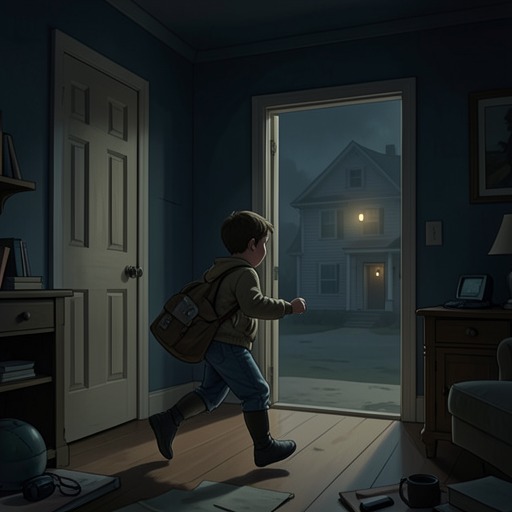
Rose, meanwhile, is in the woods with a bag and a bruised nectarine. The duration of her walk is uncertain even to the narration: it may have been an hour or her entire life. She does not imagine that anyone will simply rescue her. Instead, she reasons that alone her family has nothing, but that they can have something because of her. She sees the roof of a house through the trees, in the place she expected to find it, and takes the sight as confirmation that her search has led somewhere.
The house resembles the one the family is staying in, which heartens Rose. She follows the brick path to the front door, knocks firmly, and looks through the windows. Inside she sees flowered wallpaper, a painting of a brown horse, a brass wall light, a closed door, and a mirror reflecting her own resolute face. The house belongs to the Thornes, who are away and unable to return because domestic flights have stopped during a nationwide emergency. Rose does not know this; the reader does. Her confidence at the window therefore meets an absence she cannot yet understand.
Change and Narrative Significance
Rose’s movement from observer to searcher is the decisive change in her arc. At first she wants to share what she has seen, but the absence of proof and Archie’s dismissal leave her with knowledge that adults have not accepted. She continues to read the weather, the broken glass, the noise, and the silence on her own terms. When she later reaches the nearby house, her goal is no longer just to have her sighting believed: she thinks she can bring something back for her family, although the evidence does not establish what she will find or whether she will get inside.
Her story places a child’s limited vantage point beside the reader’s wider view of the emergency. Rose cannot see the full scale of the deer from the yard, cannot explain the noise, and does not know why the neighboring family is absent. Yet she notices changes that the adults fail to connect and acts while they are still trying to name what has gone wrong. The ending leaves her at the threshold of an empty house, carrying both the hope that she has found help and the uncertainty of what comes next.